Showing posts with label Science: Experiments. Show all posts

Saturday, May 11, 2013

Atoms, Sir Rutherford, Table of Elements & Printables


Today we were lucky enough to attend a Science Workshop all about Atoms & Molecules and the Periodic Table of Elements.....aahhhhh yes that scary thing, well at least it has always been scary to me, but thanks to this workshop it is no longer so!

One of the true blessings of home schooling, learning all over again right alongside your kids.

After a discussion about atoms, protrons, neutrons, electrons and the nucleus we learned that Democritius, a Greek philosopher who lived around 400 BC came up with the idea of cutting gold in half until he couldn’t cut it any further, he called that smallest particle the atom.

Sir Rutherford found out (around 1910) what the inside of the atom looks like and his experiment was done with gold foil.


Each child was given a sheet of paper to replicate the gold foil experiment. The paper needed to be cut in half, then in half again and in half again and in half again and so on and so on you continue cutting the piece in half (discarding the other halves) until you can no longer cut any further.

The highest number of cuts our group produced was 14. A discussion ensued as to the number of times we would need to cut our paper in half to get it down to a single atom. We had numbers from 1000 up to some ridiculous amounts that I can't even type out lol!!

In reality we would need to cut our paper in half 31 times to get it down to a single atom.
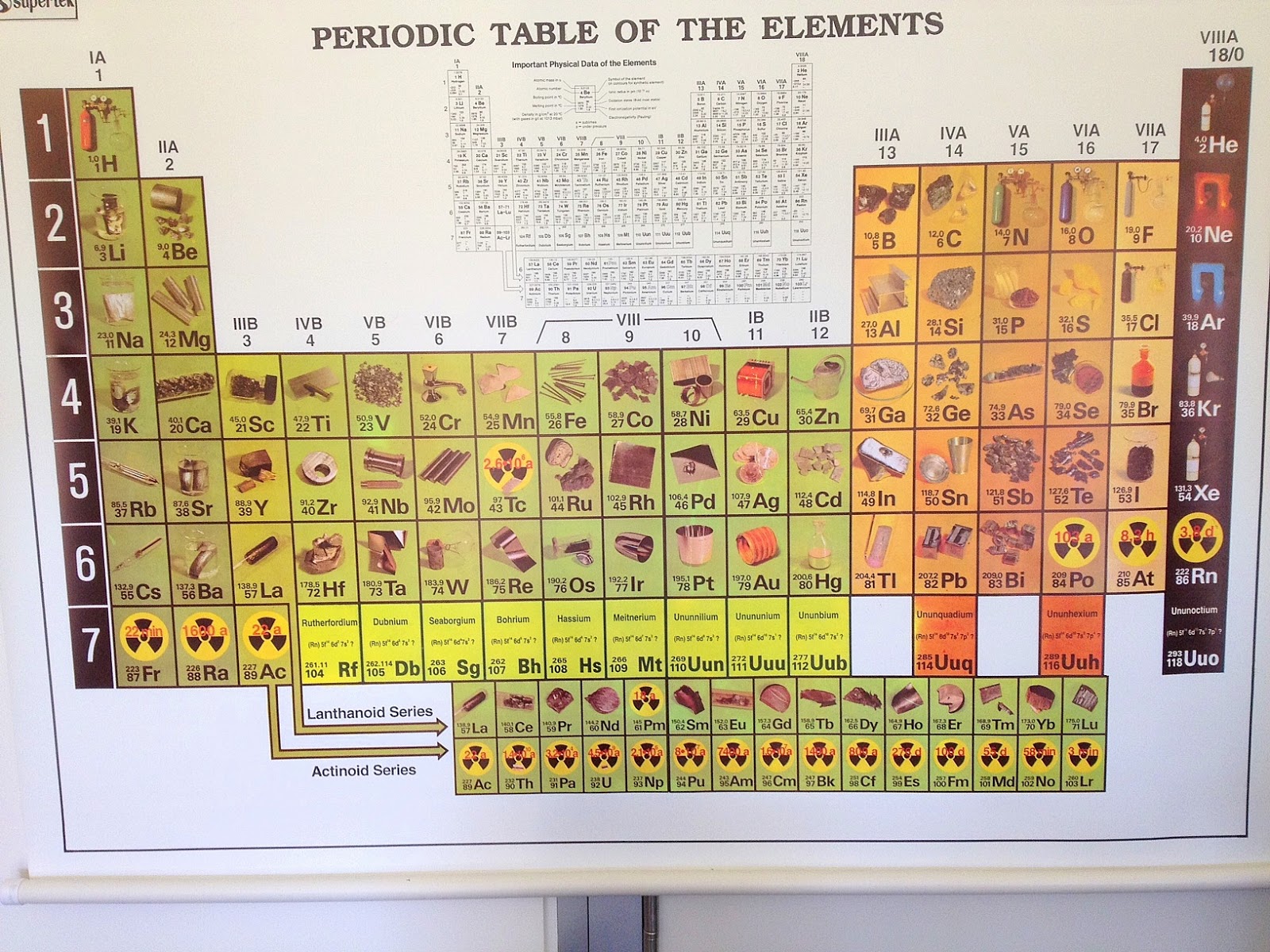

From there we went on to explore the Periodic Table of Elements. This one little chart often invokes fear in many, but when someone has the ability to explain the chart in an easily understood way all of that fear is released.


The children were all given their own copy of the chart which they would use later when building molecular structures.


After getting home from the workshop I went looking for other charts and found these very cool, full colour, FREE Printable charts. One with images and one without. Download them over here.


The same site also has this set of FREE printable Elements Cards. There are other goodies over there too and you can even order full size posters of the Elements Charts. Make sure you go and have a look.


In pairs the group did some more exploring of the elements. They were given a set of cards they needed to sort and match up. The cards included images, the element symbol and the element names. Some of these were quite tricky but certainly a good way to get loads of practice with them.


I've put together a set for my kids to use here at home so they can continue to learn the various elements. It is only a start and at some point I will add to this set but you can download a copy for your own use here.


Now that everyone had a pretty good grasp on the concept of atoms and their components and the Table of Elements we moved on to building molecular structures.


Starting off with pretty simple structures such as Water and moving along into more complex structures like Ethanol. These kits were certainly a good visual aid for seeing and understanding the structures. I've already begun looking at a kit for home use. For Australian's this is one I am currently looking at which is very reasonably priced.


This brought us to the end of the session. Here each table of children were asked to choose an element. They were given various cards with snippets of information about that element. Together in their small group (after a brief time for brainstorming and preparation) they had to present their chosen element to the larger group. A great way to round out the end of a fabulous workshop.


Some of the resources that were used during the course of the day and recommended as good to have on hand for home use.


I wanted the kids to 'wrap this up' in some way with a brief culminating activity, so I had each of them work on a notebook page for their science notebooks.


We also spent a few minutes learning a little more about Sir Rutherford and completed a "Famous Person page" about him.

Download a blank copy of this here.

Overall this was great introduction to the Periodic Table of Elements, Atoms & Molecules.

Download The Printable Materials


Be sure to have a look at Science For Home Educators they offer workshops in Australia and New Zealand and a Science at Home Awards Program available no matter where you live.

Linking this to:


Science Sunday TGIF Linky Party hosted by 123Homeschool4Me Montessori Monday

Monday, August 30, 2010

Science Sunday - Gases, Froth and Bubbles

The kids were busting their seams when I mentioned that the very hands on, very fun Professor Jellybean would be joining again this term for a couple of science experiment sessions.

They just love attending these workshops, not only are they fun and educational, they also have relatively small group sizes (average of 10 children per group this term).

But the best part has to be that each and every mum/parent/carer also gets to enjoy the excitement with the kids as not a single one of us has had to find all of the experiments, get organised to run the workshop, set up, run the group, make sure the experiments are working, nope, because all of that is done for us, all we simply need to do is enjoy the fun along with the kids.

As a homeschooling parent we are so busy planning and scheduling lessons it is such a blessing when we can access fabulous hands on activities for our children to participate in from time to time. Working and interacting with other adults outside of the home and to also be able to work alongside and with ones peers is a skill all children need.

How blessed we are to be able to provide this without having to hand over the entire education process of our children AND the best parts of their lives to someone else. It IS great to be a home schooler!


Sorry got a bit carried away there hehe.....now K doesn't look the least bit happy about participating in this does she.

The first experiment gave the children a visual of gases, something that is very difficult for a young child to fathom. They had a small continer filled with a citric acid solution. They placed a teaspoon or two of bi carb into the fingers of the glove. Whilst someone held the glove tightly around the cup, the other person lifted the glove dispersing the bi carb into the citric acid as it bubbled and the gases were released the glove 'blew up' and the kids eyes lit up!


This experiment was similar, a citric acid solution with dish soap in it, added to bi carb, a lovely fizzing, bubbling green little pot of fun.


They finished the morning off with these very cool rocket tubes. These are basically a large piece of plastic open at both ends. You begin by tying off one end and then with the other end open you very lightly blow into it (yes lightly, too hard and it doesn't work) and they seemingly instantly blow up. Grab the end and seal it shut with a rubber band.


And proceed to spend an enormous amount of time playing with them. These rocket tubes are super fun on their own but join forces with your friends and you can come up with all sorts of contraptions.

Yet another great week with Professor Jellybean.

I am linking this to Science Sunday, click on over to have a look at loads of science fun.


Vote for us. One click is all you need!


Sunday, May 23, 2010

PJ Science Week 2 - Gooey Jellyfish & Snow


This week the kids used the same solution that they used to make the Freaky Goo Worms but they also got to be a little creative with the solution and came up with Freaky Goo Jellyfish!


Neon coloured tentacles


A swirly rainbow body


Join them all together


And you have a Neon Freaky Goo Jellyfish.


They also did a couple of snow type experiments, we've used this snow material at home before so the feel of it wasn't new to my guys. Have a look at the expression on K's face though.

Professor Jellybean placed a small amount in their hands and added water and of course it exploded (grew) incredibly fast, K couldn't hold it all it was growing and spreading so fast. We've only ever done this in a tub, not held it in our hands as it absorbed the water so the feeling of that on her little fingers must of been fun.

Definitely another thumbs up for this week's round of PJ Science Fun.

Check out the other science fun posts.

Sunday, May 16, 2010

PJ Science Week 1- Freaky Goo Worms & Gooey Slime


A couple of the members of our house have taken up new professions the moment. They are pretty exciting professions too. Allow me to introduce you to them.


Meet Scientist B


And Scientist K


This week they concocted a batch of Freaky Goo Worms by mixing a seaweed protein with a calcium solution. It's the stuff that is in some of those gooey lollies and the worms really feel like a little gummi bear.


They also mixed up some colouring, glitter, PVA solution with a binding agent and hey Presto.....Gooey Slime!!


This was our first week with Professor Jellybean. She is coming along for the next 8 weeks to our homeschool network mornings to share her science fun with the kids. And fun it surely is! They all got kitted out with their lab gear and got down and dirty mixing up their experiments.

I don't have the exact ingredients as she didn't give them away but I am sure some googling will produce results. The slime is fabulous and those gooey worms, you need to remind yourself that they ARE NOT lollies hehehehe!

So ok we might be cheating a bit for Science Sunday, since we didn't actually do these at home but they were super fun and our budding little scientists are itching to see what they will come up with this week.

Check out the other Science Sunday fun Posts.

Friday, February 26, 2010

The Science of Bubbles

We dug into one of our Science Kits this week and were up to our armfuls in bubbles. I purchased several of these themed science kits some time ago when Aldi had them all on special. I hadn't even taken a peak inside so I had no idea what to expect.

Considering that they were super cheap I was very pleasantly surprised. The kit (well at least this one) contained all of the bits and pieces for 16 different activities/experiments (except maybe a bowl here and there and possibly extra bubble mixture if you go overboard). It also has a booklet with loads of information about bubbles and all of the details for each of the experiments/activities. Super easy, grab it off the shelf, choose the experiment and off you go!


We learnt how to prepare our own bubble solution using soap, distilled water and glycerin. We talked about what exactly a soap bubble was. This covered topics such as, minimal surface structures, volume, molecules, surface tension.

How nature uses the same principles of bubbles attaching themsevles to one another at 120 deg forming hexagons, such as in a beehive. And how man has also used the same principles to build structures, such as the Munich Olympic Stadium.


We made Bubble Harmoninca's. To do this yourself you will need a piece of fluted plastic, 2 plastic slides (or equivalent), a rubber band and some bubble mixture.

Dip one side of the harmnonica in the bubble mixture and blow through the other side.


We blew some bubble chains. Join six straws together with a rubber band, dip one end into the bubble mixture and blow gently from the other. You will make a long chain of bubbles.

This is a fabulous way to show how the bubbles attach to themselves at a 120 deg angle.

You need to get your 'blowing' fine tuned to make perfect chains though. Too hard and the bubbles will just fly out the end, too soft and you'll barely make a bubble at all.


We had a go at making giant bubbles. All you need is a funnel and the bubble mixture. Dip the wide end of the funnel in the mixture and blow. This is harder than it looks.


We made coloured bubbles. I believe that tempura paint is best for this activity but we didn't have any on hand so we used food colouring instead.

Place a small amount of bubble mixture in a bowl, some water and food colouring. The more colouring you add the more intense the colours will be.

Blow lots and lots of bubbles. Place a piece of paper over the bubbles, as they pop they will leave a print on the paper.


We had some success with the food colouring. Although no one overly enjoyed this activity, apparently the mixture got up their noses, in the eyes and in their mouths when they accidentally sucked instead of blowing!!


Related Posts with Thumbnails
 

Blog Design by: Relevant Designs